
From royal regalia and national masterpieces to the aircraft that defended Britain’s skies, London’s museums and historic buildings contain objects that tell the nation’s story. Chris Johnson selects 10 treasures worth crossing the capital to see.
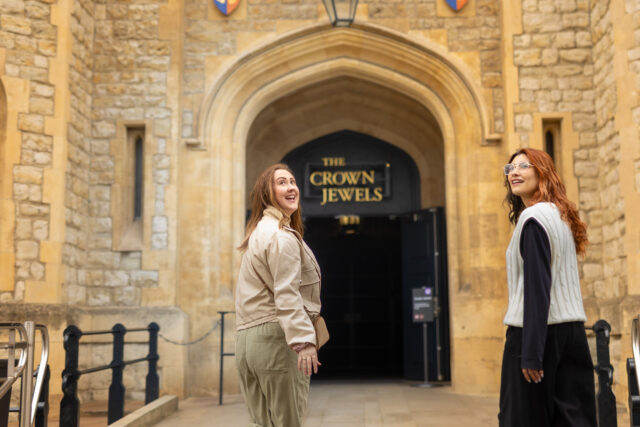
1. The Crown Jewels, Tower of London
Protected at the Tower since the 1660s, the Crown Jewels comprise more than 100 objects set with over 23,000 gemstones. At the heart of the collection is the Coronation Regalia, still used when a new monarch is crowned. Look out for St Edward’s Crown, and the elegant King’s Sceptre with Cross, which holds the 530.2-carat Cullinan I – the world’s largest colourless cut diamond. The Imperial State Crown contains another 2,868 diamonds.
One apparent jewel, however, is not quite what it seems: the Black Prince’s Ruby is in fact a large red spinel (a similarly coloured gemstone). This is no retired collection, either. Pieces are still worn at coronations – including that of King Charles III – as well as at the State Opening of Parliament.
2. Ophelia, Tate Britain
Floating among flowers, Shakespeare’s doomed heroine gazes upwards in one of the defining images of Victorian art. Sir John Everett Millais painted Ophelia in 1851-52, bringing the tragic scene from Hamlet to life with the intense colour and natural detail associated with the radical Pre-Raphaelite Brotherhood, which he helped to found in London.
The flowers pictured carry their own meanings: the poppy suggests death, daisies imply innocence and pansies hint at love in vain. The model was Elizabeth Siddal, herself a talented artist and poet rather than simply a Pre-Raphaelite muse. Take a closer look at the surrounding vegetation: Millais’ work was celebrated in its day for its painstakingly accurate study of nature. Visit Tate Britain.
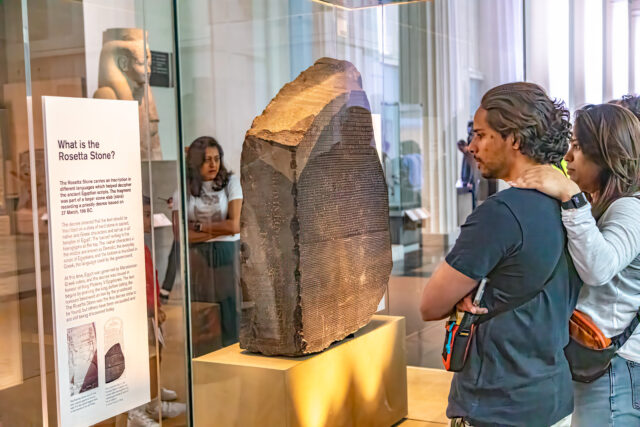
3. Rosetta Stone, The British Museum
The most famous rock in the world provided the key to reading ancient Egyptian hieroglyphs. Created in 196 BC, this fragment of a much larger stone slab carries three different scripts: demotic, ancient Greek, and, of course, hieroglyphic. That repetition allowed scholars to compare the texts and begin unlocking a complex writing system that had resisted understanding for centuries.
Discovered by French soldiers near the Egyptian town of Rashid, or Rosetta, in 1799, the stone entered The British Museum in 1802. Despite its exalted scholarly reputation, the message is not a forgotten spell or secret prophecy. It is a public statement supporting the royal cult of the 13-year-old King Ptolemy V Epiphanes.
4. Magna Carta, The British Library
Issued by King John in 1215 following a confrontation with his rebellious barons, the Magna Carta has become an international symbol of liberty. Meaning ‘Great Charter’, it established the principle that no one, neither the monarch nor the government, is above the law.
It was first agreed and sealed at Runnymede, west of London, although the original settlement quickly collapsed and the charter was reissued under later monarchs. Only four copies of the document dating from 1215 survive, and The British Library holds two of them. Its most enduring clauses include the declaration that justice should neither be sold nor delayed.
5. The Coronation Chair, Westminster Abbey
For more than 700 years, this oak chair has occupied a vital role in the crowning of Britain’s monarchs. It was commissioned by Edward I in around 1300 to enclose the Stone of Scone (the traditional crowning seat for Scottish kings), which had been brought from Scotland in 1296.
Originally gilded and richly decorated with images of birds, foliage and animals, it would have looked very different from the somewhat weathered chair seen in Westminster Abbey today. Its many scratches include centuries-old visitor graffiti; one bold inscription records that ‘P. Abbott slept in this chair’ in July 1800. The Stone returned permanently to Scotland in 1996 but is reunited with the chair for coronations.
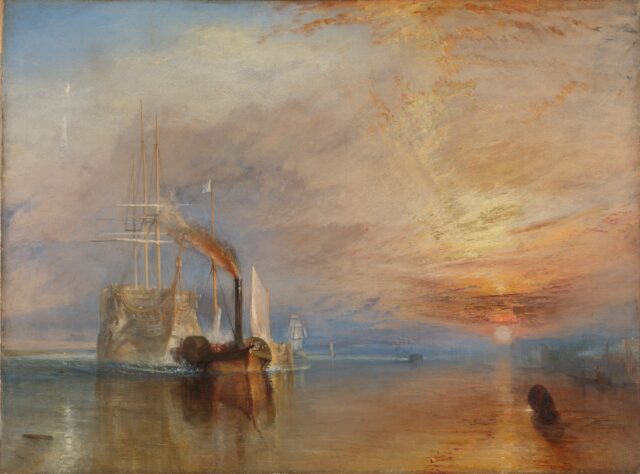
6. The Fighting Temeraire, The National Gallery
JMW Turner’s masterpiece depicts a veteran warship being towed along the River Thames to a breaker’s yard at Rotherhithe in 1838. HMS Temeraire had helped defend Nelson’s flagship, HMS Victory, at the Battle of Trafalgar in 1805.
In Turner’s painting, the ghostly sailing ship is pulled by a small, smoke-belching steam tug as the sun sets; a powerful farewell to the age of sail. Yet the master took considerable artistic licence with his subject matter: the ship’s masts had already been removed, two tugs were used and the sunset appears in the wrong direction.
The artist refused to sell the work, affectionately calling it his ‘darling’, and left it to the nation – now proudly displayed in The National Gallery.
7. Nelson’s Trafalgar Coat, National Maritime Museum
Few objects bring the human cost of history closer than the uniform that Vice-Admiral Horatio Nelson wore for the Battle of Trafalgar on 21 October 1805. Britain defeated the combined French and Spanish fleets, frustrating Napoleon’s invasion plans, but Nelson was fatally wounded by a musket shot.
The bullet hole remains visible near the left shoulder of his blue wool coat. Bloodstains on its tails and sleeve are thought to belong to his secretary, John Scott, who was killed earlier in the battle. The Vice-Admiral’s four orders of chivalry are sewn directly onto the coat, crossing its lapel so that it could not be fully unbuttoned.
After his death, Nelson received a state funeral at St Paul’s Cathedral before being buried in the crypt.
Plan your visit to the National Maritime Museum.
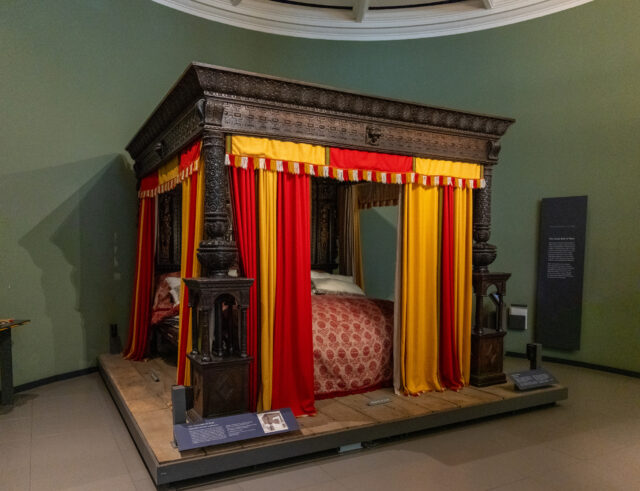
8. The Great Bed of Ware, V&A South Kensington
Measuring more than three metres across, this monumental four-poster bed reputedly had room for at least four couples. It was most probably made in around 1590 as an attraction for tourists at an inn in Ware, a Hertfordshire coaching town approximately a day’s journey from London at the time.
Travellers carved their initials into its wood or attached red wax seals to prove they had spent the night there; their marks can still be seen. The bed was already famous during Shakespeare’s lifetime. In Twelfth Night, Sir Toby Belch demands a sheet of paper big enough for the bed’s carved lions and satyrs symbolise virility and fertility, all adding to the bed’s rather mischievous reputation.
View it in Room 57 at V&A South Kensington.
9. The Battle of Britain Spitfire, IWM London
With its graceful curves and distinctive elliptical wings, the Supermarine Spitfire became an enduring symbol of British defiance during World War II. The example suspended in the atrium of IWM London was built in 1940 and is associated with the Battle of Britain, when RAF pilots resisted attempts by the German Luftwaffe to gain control of Britain’s skies and mount a Nazi invasion of the UK.
Designed by RJ Mitchell and powered by a Rolls-Royce Merlin engine, the agile fighter was continually adapted as the conflict developed with more than 20,000 Spitfires eventually built. It was also the only Allied frontline fighter to remain in continuous development throughout the war, evolving from the Mk I to the Mk 24.
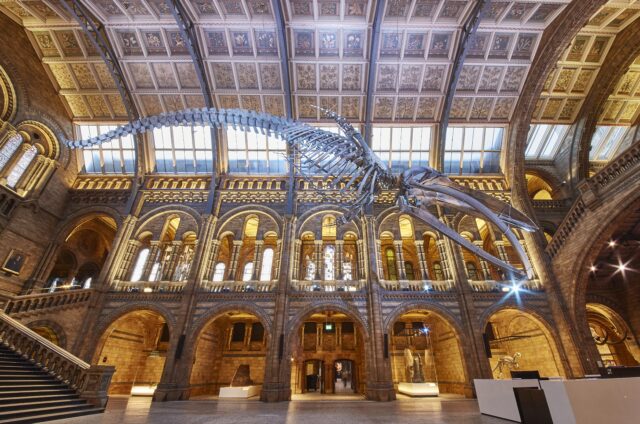
10. Hope the Blue Whale skeleton, Natural History Museum
Suspended dramatically above the Natural History Museum‘s elegant Hintze Hall, Hope is the 25.2m-long skeleton of a female blue whale – a member of the largest species ever known to have lived.
She became stranded near Wexford, Ireland, in March 1891 and her skeleton was later acquired by the Natural History Museum for £250. Comprising 221 bones and weighing around 4.5 tonnes, it was moved into the hall in 2017 and arranged in a dynamic lunge-feeding position.
Scientists studying her baleen (a whale’s filter feeding system) have since discovered that she had probably become a mother shortly before her death. Her name reflects the recovery of blue-whale populations after being granted international protection, transforming this Victorian specimen into a symbol of humanity’s ability to protect the natural world.
She’s also a fitting end to a trail of cultural icons that are sure to amaze and delight visitors for many years to come.