
Gothic novels, children’s classics and screen favourites have all found new life on the stage. Chris Johnson explores how the capital’s finest adaptations don’t simply reproduce their source material – they transform it.
Some of London’s biggest theatrical worlds began on the page. This winter, audiences can descend beneath the Paris Opera House, enter Oz before Dorothy arrives, join the barricades of 1832 Paris or follow a small bear from Peru across London.
A great adaptation, however, is about more than familiarity. Theatre must reinvent a story in three dimensions, turning thought into song, conflict into movement and imagined worlds into something immediate and shared. At its best, adaptation gives a familiar story an entirely new theatrical life.
Gothic grandeur and untold stories
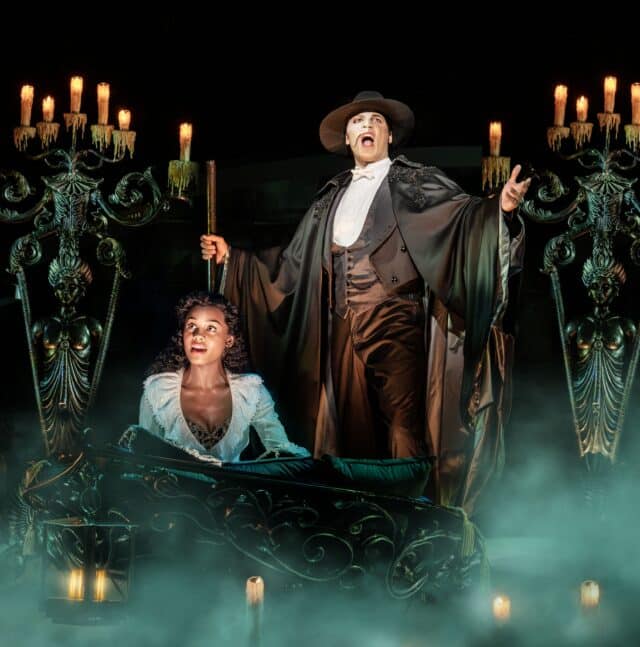
Few productions demonstrate that transformation more spectacularly than Phantom of the Opera at His Majesty’s Theatre. Andrew Lloyd Webber’s musical takes Gaston Leroux’s 1910 gothic novel and makes its central obsession sing. The Phantom’s subterranean world becomes a place of candlelight, spectacle and soaring melody, while songs such as The Music of the Night and All I Ask of You give the relationship between The Phantom, Christine and Raoul an emotional immediacy that prose alone cannot provide. Having celebrated 40 years in London this October, the show is also a reminder that an adaptation can become a classic in its own right.
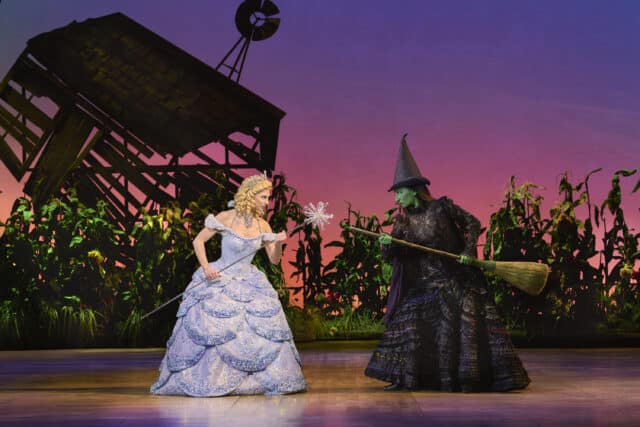
Wicked, which marked 20 years at the Apollo Victoria Theatre this September, performs a different kind of transformation. Gregory Maguire’s 1995 novel reimagined the world of Oz; the musical, with a book by Winnie Holzman and music and lyrics by Stephen Schwartz, reshapes that revisionist story around the friendship between Elphaba and Glinda. The result is both familiar and surprising: audiences recognise the mythology of the Wicked Witch and the Good Witch but encounter the people behind the labels. Defying Gravity turns a private decision into a powerful shared theatrical moment.
At the Sondheim Theatre, Les Misérables applies the same principle on an epic scale. Victor Hugo’s vast novel becomes a propulsive musical drama in which recurring melodies carry memory, love, sacrifice and revolution through years of upheaval. The score allows individual stories – Jean Valjean’s redemption, Fantine’s despair and Éponine’s unrequited love – to sit inside a sweeping historical canvas without losing their human scale.
Children will be children
For family stories, the challenge is different: how do you honour images readers already carry in their heads while creating something that could only happen on stage?
Matilda The Musical, celebrating 15 years in the West End at the Cambridge Theatre, is one of the clearest answers. The Royal Shakespeare Company’s adaptation of Roald Dahl’s novel combines Dennis Kelly’s book with Tim Minchin’s witty, rebellious songs. Its theatrical language is playful rather than literal. During 2010 rehearsals for When I Grow Up, the company experimented with playground equipment as it searched for the right staging – a good example of the invention behind the show.
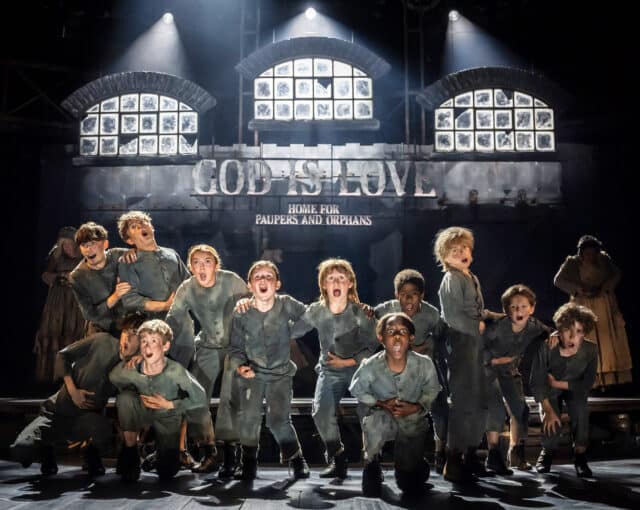
Oliver! at the Gielgud Theatre turns another British literary landmark into musical theatre. Lionel Bart’s adaptation of Charles Dickens’ Oliver Twist uses songs including Food, Glorious Food and Consider Yourself to give the novel’s crowded Victorian world a communal voice. Cameron Mackintosh’s current production, fully reconceived with director and choreographer Matthew Bourne, uses choreography, design and music to create momentum. The story of a boy asking for more becomes, quite literally, something an entire company can sing.
A bear built for the stage
Paddington The Musical at the Savoy Theatre shows how adaptation can travel through more than one medium. The production is based on Michael Bond’s characters, with a story inspired by the award-winning 2014 film and a book by Jessica Swale, alongside original music and lyrics by Tom Fletcher. Bringing those elements together on stage creates a particular challenge: how to retain the warmth and familiarity audiences expect while making the story feel fresh in a live setting.
The answer is not to imitate either the film or the books. Songs and choreography create their own kind of magic, turning Paddington’s encounters with the Brown family and London into something communal. A story associated with kindness, belonging and a very particular bear’s view of the capital becomes a live love letter to the city.
Winter storybooks
November and December bring an especially rich crop of page-to-stage family adventures. At the National Theatre, Anupama Chandrasekhar adapts Rudyard Kipling’s The Jungle Book for the Olivier stage (13 Nov-6 Feb). Directed by Indhu Rubasingham, the production uses innovative puppetry by Finn Caldwell and Nick Barnes to bring the animals of the Sundarbans to life.
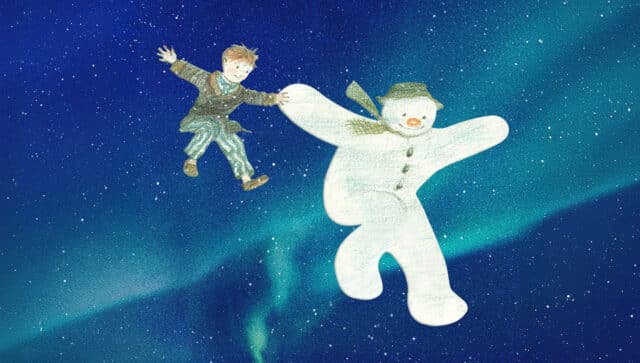
Meanwhile, Raymond Briggs supplies not one but two festive favourites. Raymond Briggs’ Father Christmas returns to the Lyric Hammersmith theatre (18 Nov-27 Dec), adapted by Pins & Needles Productions, while The Snowman lands at the Peacock Theatre (21 Nov-3 Jan) in a brand-new Birmingham Repertory Theatre production featuring puppetry and Howard Blake’s iconic score, including, of course, Walking in the Air. Director Will Tuckett sums up its appeal neatly: ‘I want adults to become children and children never to forget it.’
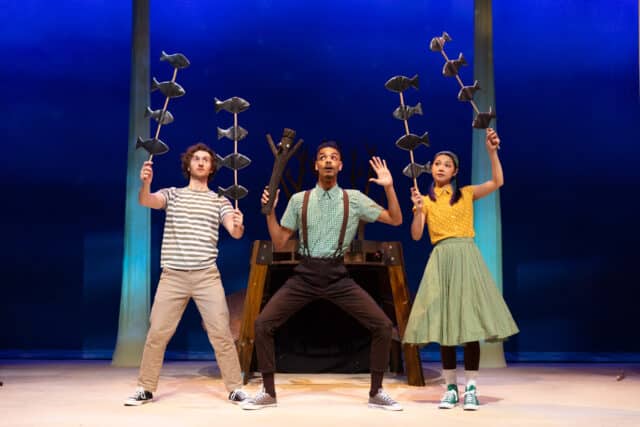
Julia Donaldson and Axel Scheffler’s picture-book worlds also leap off the page. Tall Stories’ Room on the Broom flies into the Lyric Theatre (27 Nov-3 Jan) with music, puppetry and imaginative live performance, while Freckle Productions’ Stick Man is at the Bloomsbury Theatre (3 Dec-3 Jan), where a trio of actors use songs and live music to turn the much-loved picture book into a one-hour stage adventure.
That is ultimately why these stories keep being adapted. We may arrive knowing the characters, the ending or even the songs. What theatre adds is presence: performers breathing the same air, music filling the auditorium and an audience discovering a familiar story together. The journey isn’t recreating what came before. It is about reimagining the story and finding the moment when it comes alive.