
This year marks 100 years since Leighton House opened as a public museum, with the exhibition Leighton House: A Journey through 100 Years charting its remarkable evolution.
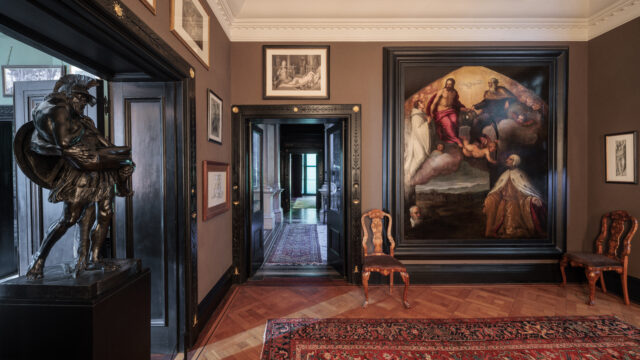
Love comes in many forms, and for the Victorian artist Lord Frederic Leighton (1830-1896), his greatest passion was his home. Nestled in leafy Holland Park, Leighton House stands as a testament to its owner’s artistic vision and devotion. From 1864 until Leighton’s death, the house evolved constantly under his creative eye, refined and redefined as both a living space displaying his treasures and a studio.
Featuring sumptuous interiors, ravishing paintings and eclectic artefacts, it is hard not to be captivated by the exotic beauty of Leighton House Museum. A home, studio, entertaining space and gallery all in one, the house is as much an ode to love as it is a place to view art. Every room reflects Leighton’s meticulous taste and his fascination with beauty drawn from different cultures and periods.
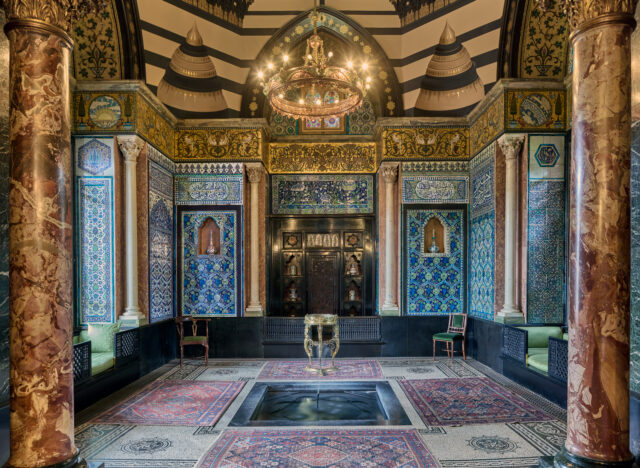
At the heart of the house is the Arab Hall, a jewel-like shrine to Islamic decorative art, with glinting tiles, shimmering mosaics and a courtyard fountain. Ascending the adjacent staircase, visitors encounter striking works such as Silent Noon by John Byam Liston Shaw (1872-1919). Inspired by a poem by Dante Gabriel Rossetti, the painting depicts an idyllic scene of lovers resting in a sun-drenched meadow.
Upstairs is the Silk Room, where walls lined with rich green silk enhance romantic paintings by Leighton’s contemporaries alongside his own sensuous works, at the core of the collection. Often drawing on Greek mythology, Leighton idealised beauty and the female form. A focal point is Orpheus and Eurydice, showing Orpheus on the brink of breaking the rule forbidding him from looking at his wife as he tries to rescue her from Hades. Elsewhere, Clytie (c.1895) references the Ovidian myth of the water nymph’s unrequited love for the sun god Apollo. It was Leighton’s final, unfinished painting.
‘Frederic Leighton lived alone in his magnificent studio house and, despite rumours, never married,’ says Hannah Lund, curator for exhibitions and displays. ‘His lasting love was art – a passion that continues to inspire visitors today.’
Leighton House: A Journey through 100 Years runs to 1 Mar.
BEATRICE SQUIRES